
DDR5 has been available for a while now, but DDR4 hasn’t gone away — it’s still widely sold, still supported on plenty of current platforms, and often cheaper. Deciding between them isn’t purely about which is newer; it depends on which CPU platform you’re building around and whether the extra bandwidth DDR5 offers actually benefits what you do with your PC. This comparison covers the real technical differences and gives a straight answer on whether paying more for DDR5 makes sense for you.
| Factor | DDR4 | DDR5 |
|---|---|---|
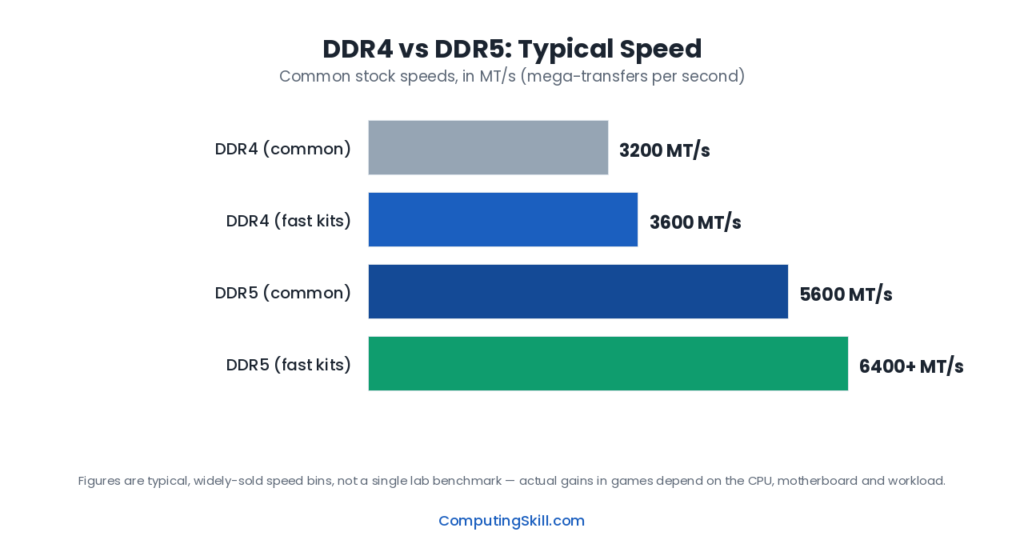
| Typical rated speeds | Commonly 2133-3600 MT/s stock, higher with overclocking/XMP | Launched with higher rated speeds than DDR4 and has continued climbing since |
| Bandwidth | Lower per-module bandwidth | Higher per-module bandwidth due to higher transfer rates and improved architecture |
| Latency (in absolute time) | Generally lower absolute latency at launch-era speeds | Higher CAS latency numbers at launch, though effective real-world latency has improved as DDR5 has matured |
| Price | Cheaper, mature and widely available | More expensive, though the gap has narrowed since launch |
| Platform support | AM4 (Ryzen 5000 and earlier), Intel platforms through roughly 12th/13th Gen boards using DDR4 chipsets | AM5 (Ryzen 7000 and later), Intel platforms with DDR5-only boards (12th Gen onward on DDR5 boards) |
| Voltage / power | Standard 1.2V | Lower standard voltage (1.1V), with on-module power management (PMIC) built into the module itself |
| Real-world gaming impact today | Still very competitive for most games | Modest gains in many titles, more noticeable in memory-bandwidth-sensitive workloads |
Bandwidth and Speed
DDR5 was designed from the ground up for higher data transfer rates than DDR4, launching with rated speeds above what DDR4 topped out at, and speeds have continued to increase as DDR5 kits have matured. This translates into meaningfully higher peak memory bandwidth — useful for workloads that move large amounts of data through memory quickly, such as content creation, some professional applications, and certain memory-sensitive games and engines.
DDR5 also changed its internal architecture, splitting each module into two independent 32-bit sub-channels instead of DDR4’s single 64-bit channel per module. This improves efficiency for handling multiple simultaneous memory requests, which particularly benefits multi-core CPUs and integrated graphics that lean on system memory bandwidth.
Latency Tradeoffs
Raw bandwidth isn’t the whole story. Latency — how long it takes memory to respond to a single request — matters for many everyday and gaming workloads. DDR5 launched with higher CAS latency timings (in clock cycles) than mature DDR4 kits, and because DDR5’s clock speeds were also much higher at launch, the actual real-world latency in absolute time wasn’t dramatically better than well-tuned DDR4, and in some early comparisons was arguably a bit worse for latency-sensitive tasks.
As DDR5 has matured, faster kits with tighter timings have become available, narrowing or closing that early latency disadvantage in many cases. The practical takeaway: DDR5’s advantage is primarily about bandwidth, and its latency situation has improved over time but isn’t automatically better than a well-tuned DDR4 kit in every scenario.
Price: Is the Premium Still Significant?
At launch, DDR5 carried a substantial price premium over DDR4 for comparable capacity. That gap has narrowed considerably since, as DDR5 production has scaled up and DDR4 has become a legacy technology on its way to being phased out of new platforms. DDR4 remains generally cheaper today, particularly at common capacities, but the price-per-GB gap to DDR5 is no longer as dramatic as it was at DDR5’s introduction.
Whether that remaining premium is worth paying depends mostly on your platform choice (see below) rather than on DDR5 being clearly “better value” on its own — if your CPU platform requires DDR5, the price difference isn’t really optional.
Platform and Socket Compatibility
This is the part that actually decides the question for most builders: DDR4 and DDR5 are not interchangeable, and your CPU platform dictates which one you must use.
- AMD AM4 platform (Ryzen 5000 series and earlier, including chips like the Ryzen 5 5600 and Ryzen 7 5700X) uses DDR4 exclusively. There is no DDR5 option on AM4.
- AMD AM5 platform (Ryzen 7000 series and later, including chips like the Ryzen 5 7600 and Ryzen 9 7900X) uses DDR5 exclusively. There is no DDR4 option on AM5.
- Intel platforms are more mixed — motherboards for the same CPU generation are sold in both DDR4 and DDR5 variants on some generations, so the memory type depends on the specific motherboard chipset and board you choose, not solely the CPU generation.
In practice, this means the DDR4-vs-DDR5 decision is usually made for you the moment you pick a CPU and motherboard combination — you’re rarely choosing memory type independently of the rest of your platform. Use the PC Compatibility Checker to confirm exactly which memory type your intended CPU and motherboard combination requires before buying RAM.
Which Should You Choose?
If you’re building a new PC on a current AM5 or DDR5-only Intel platform, the choice is made for you — buy DDR5, since DDR4 isn’t an option on those boards. In this case, don’t agonize over the price premium; it’s simply the cost of the platform.
If you’re building or upgrading on an AM4 platform, or an Intel platform with DDR4-based boards, DDR4 remains a perfectly reasonable, cost-effective choice today — you’re not meaningfully handicapping a mid-range gaming build by staying on DDR4, and the money saved can often go further elsewhere in the build, such as a better GPU.
If you’re upgrading an existing DDR4 system and wondering whether to jump platforms specifically to get DDR5, that’s rarely worth it in isolation — a full platform change (new motherboard, new CPU, and new RAM together) is a significant cost for a bandwidth gain that shows up clearly only in specific bandwidth-sensitive workloads, and only modestly in most games. It makes far more sense to upgrade to DDR5 as part of a broader platform upgrade you were already planning, rather than chasing DDR5 memory bandwidth on its own. For a broader look at whether now is the right time to upgrade your platform at all, see How to Upgrade a Gaming PC.
Frequently Asked Questions
Can I mix DDR4 and DDR5 in the same PC?
No. DDR4 and DDR5 modules are physically different (different notch positions and pin layouts) and are not interchangeable or compatible with each other’s slots. Your motherboard supports one type or the other, never both.
Is DDR5 much faster than DDR4 for gaming?
In most games, the difference is modest rather than dramatic, since gaming performance depends on many factors beyond memory bandwidth alone. Memory-bandwidth-sensitive titles and scenarios (including some integrated graphics use cases) show a more noticeable benefit from DDR5.
Does DDR5 use more or less power than DDR4?
DDR5 runs at a lower standard voltage than DDR4 and includes on-module power management, which generally makes it more power-efficient per operation, even though its higher speeds mean overall module power draw isn’t simply lower across the board.
Should I buy a DDR4 motherboard today to save money?
It depends on the CPU platform you’re targeting. If you’re on AM4 or a DDR4-based Intel board already, sticking with DDR4 is a reasonable cost-saving choice. If you’re buying new on a platform that only supports DDR5 (like AM5), the choice isn’t really optional.
Will DDR4 become obsolete soon?
It’s gradually being phased out of new CPU platforms as newer generations move to DDR5-only designs, but DDR4 remains supported, available, and perfectly usable on existing and some current platforms for the foreseeable future.